Trois-Rivières sits at 61 meters above sea level, where the Saint-Maurice River meets the St. Lawrence. But elevation tells only part of the story. The real challenge lies underground. Post-glacial Champlain Sea clays dominate the subsurface across much of the city. These sensitive silts lose strength fast when disturbed. A soil mechanics study becomes the first line of defense against differential settlement. Before excavation begins on Boulevard des Forges or near the Laviolette Bridge approach, the stratigraphy needs to be mapped. Our laboratory team runs the tests that matter: consolidation, shear strength, and classification. The NBCC 2020 requires it. Owners who skip this step learn the hard way. Cracked slabs. Leaning walls. Budgets blown by spring thaw surprises. We have seen what the Saint-Maurice clay can do. It does not forgive shortcuts.
Champlain Sea clay in Trois-Rivières can lose over 80% of its undisturbed strength when remolded. That sensitivity dictates foundation design.
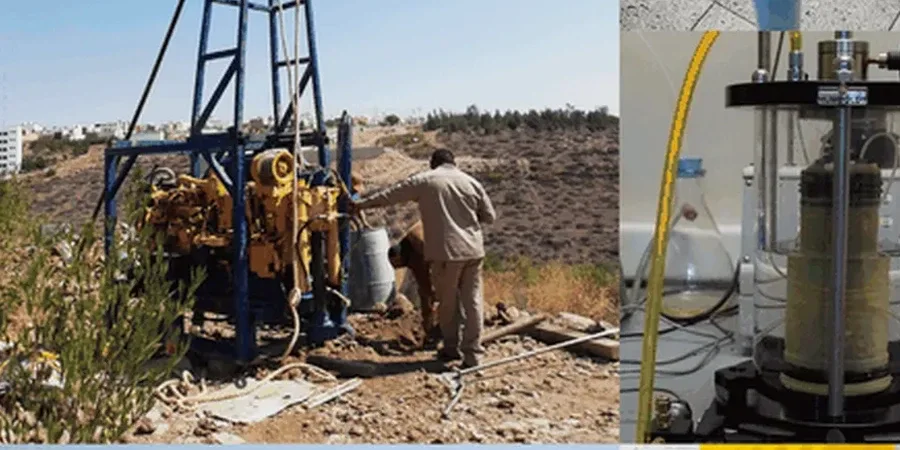
Methodology applied in Trois-Rivieres
Critical ground factors in Trois-Rivieres
A six-story condominium planned near Rue Royale hit a buried peat pocket at 4 meters. The auger dropped 30 centimeters in one rotation. Nobody saw it coming from the surface. A soil mechanics study with closely spaced boreholes mapped the organic lens before structural design locked in. The fix was a transition slab and targeted over-excavation. Without that data, the differential settlement would have cracked shear walls within five years. This is not theoretical risk. It is the reality of building on a river delta. The Saint-Maurice deposited erratic layers for millennia. A single borehole at the corner of a lot cannot capture that variability. Good geotechnical engineering means enough investigation points to connect the dots between clay, silt, till, and bedrock.
Our services
Every project in Trois-Rivières requires a tailored scope. The investigation depth and lab testing program depend on what you are building and where. These are the core components we deliver.
Foundation Design Parameter Study
Complete evaluation of bearing capacity and settlement for shallow footings, mat foundations, or deep piles in the Champlain Sea clay.
Seismic Site Classification
Shear wave velocity measurement and liquefaction assessment per NBCC 2020 seismic hazard values for the Trois-Rivières region.
Slope Stability and Excavation Analysis
Evaluation of temporary cut slopes and permanent embankments in sensitive clay, including the effect of groundwater drawdown during construction.
Top questions
What depth of investigation is required for a building in Trois-Rivières?
It depends on the foundation type and footprint. For a typical mid-rise on footings, boreholes usually extend 15 to 25 meters to pass through the Champlain Sea clay and reach competent till or bedrock. Heavier structures or deep excavations may require deeper investigation. The NBCC mandates a minimum number of boreholes based on building area.
How much does a soil mechanics study cost in Trois-Rivières?
A complete soil mechanics study including drilling, sampling, and laboratory testing typically ranges from CA$4,240 to CA$8,170. The final figure depends on the number of boreholes, sampling interval, and the specific lab tests required for your structural design.
Why is the Champlain Sea clay so problematic for construction?
This marine clay has a high sensitivity, meaning it can transform from a solid to a liquid-like state when vibrated or remolded. Even modest excavation can trigger flow slides if not properly managed. Its high compressibility also causes significant long-term settlement under load.
What lab tests are essential for this type of study?
The essential suite includes water content, Atterberg limits, grain size analysis, oedometer consolidation, and triaxial shear tests. For seismic design, we often add resonant column or bender element tests to measure small-strain shear modulus.