The St. Lawrence lowlands near Trois-Rivières sit on a deep sequence of post-glacial marine clays, often exceeding 20 meters in thickness. Beneath several neighborhoods, these Champlain Sea deposits alternate with silty till lenses that control groundwater movement in unexpected ways. A standard lab test on a disturbed sample won't capture the real hydraulic conductivity of these stratified soils. For that, we run the Lefranc test in boreholes above the water table or the Lugeon test in bedrock intervals, measuring permeability directly at depth. Results from test pits often hint at percolation issues, but field permeability data is what confirms whether a dewatering system or an infiltration basin will actually work in Trois-Rivières soil.
Lugeon values above 25 in local shale mean grout take will be high—plan the mix design accordingly.
Methodology applied in Trois-Rivieres
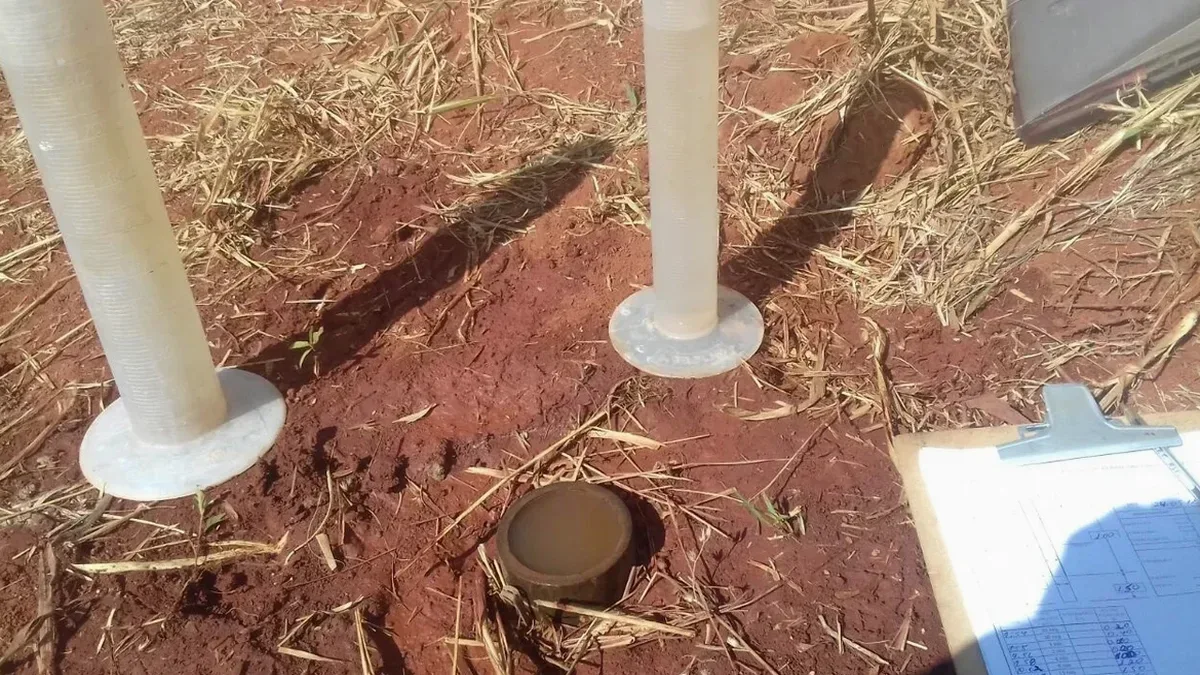
Critical ground factors in Trois-Rivieres
On a recent excavation near the St. Maurice River, the contractor assumed the clay was practically impermeable and skipped the field test. Water started seeping through a silt seam at 6 meters, saturating the base and delaying the pour by three weeks. In Trois-Rivières, that silt layer is almost always present somewhere in the profile. Omitting the in-situ permeability test means guessing the location of the seepage path. We've seen similar scenarios where a retaining wall design had to be revised mid-project because the drainage assumptions didn't match the real hydraulic conductivity. A half-day test prevents that.
Our services
We run two configurations depending on the overburden and rock quality encountered in Trois-Rivières boreholes.
Lefranc Test (Soil)
We set a slotted pipe in the test interval, fill the standpipe, and record the water level drop over time. This gives a direct k value for the specific stratum—critical for dewatering design in the Champlain clay basin.
Lugeon Test (Rock)
We inject water at constant pressure into an isolated section of bedrock. The water take in liters per meter per minute defines the Lugeon value. Used to assess groutability and fracture connectivity in the Appalachian foothills north of the city.
Top questions
What does a Lefranc or Lugeon test cost in Trois-Rivières?
Budget between CA$890 and CA$1,530 per test interval, depending on depth, access, and whether we use a single or double packer. Mobilization and reporting are included. If we're already on site with a drill rig for SPT or rock coring, the incremental cost drops.
How long does it take to get the permeability results?
The field test itself takes 30 to 90 minutes per interval. We deliver the full report with k values, depth profiles, and interpretation within 3 to 5 business days after completing field work.
Can you run a Lugeon test in fractured shale?
Yes. The Lugeon test is designed specifically for fractured rock. In the shale and limestone north of Trois-Rivières, we typically use a double packer to isolate short intervals and get a reliable measurement of fracture permeability without short-circuiting along the borehole wall.
Why not just use a lab permeability test on a soil sample?
Lab tests on small samples miss macropores, fissures, and thin silt seams that control field-scale flow. In Trois-Rivières' layered marine deposits, the in-situ test measures the bulk hydraulic conductivity of the formation as it actually behaves—sample disturbance is eliminated.