Overlooking the subtle transition from dense till to sensitive marine clay is a costly mistake we've seen repeatedly on Trois-Rivières construction sites. A standard borehole might miss a thin, weak layer, but the cone penetration test captures it. Our laboratory team runs CPT campaigns across the Mauricie region to eliminate that guesswork, providing a continuous resistivity and tip resistance profile that standard SPT methods simply cannot match. The St. Lawrence lowlands, where Trois-Rivières sits at an elevation of roughly 50 meters, are underlain by post-glacial Champlain Sea deposits—materials that demand pore pressure measurement during penetration to assess drainage behavior. Before committing to a deep foundation scheme, pairing the CPT data with a targeted triaxial test on undisturbed samples validates the strength parameters, while understanding the regional seismic response often requires a seismic microzonation study to integrate with the site-specific shear wave velocity from a seismic CPT.
A single CPT sounding in Trois-Rivières marine clay can replace four SPT borings while delivering a pore pressure dissipation curve that defines the consolidation coefficient.
Methodology applied in Trois-Rivieres
Critical ground factors in Trois-Rivieres
A 6-storey residential project on des Forges Boulevard was initially designed using SPT N-values from a nearby site. The numbers looked adequate—until our CPT profile revealed a 1.8-meter band of extra-sensitive clay at 11 meters depth, with a remolded shear strength below 5 kPa. The original spread footing concept would have failed progressively. A cone penetration test doesn't just count blows; it reads the pore pressure spike that screams 'sensitive clay' in Trois-Rivières. Without that dissipation test, the excess pore pressure generated during driving or piling can trigger a flow slide in these Champlain Sea sediments. We recommended switching to a deep foundation with piles socketed into the underlying till, verified by a dissipation test to ensure the design pore pressure parameters were conservative. The cost of the CPT was less than 2% of the foundation budget, but it prevented a bearing capacity failure that would have halted construction for months.
Our services
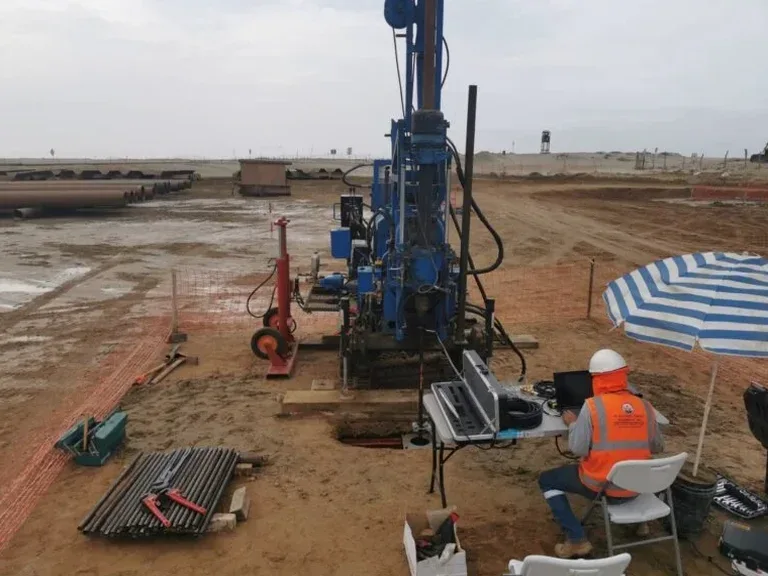
Our Trois-Rivières CPT service combines field execution with laboratory-backed interpretation. Each sounding produces a digital log with corrected cone resistance, friction ratio, and pore pressure ratio, overlaid on the Robertson (1990) SBT chart. We handle the logistics of truck access on tight urban lots and work with local drilling contractors when pre-drilling through fill or pavement is necessary.
Piezocone (CPTu) Sounding
Full u₂ pore pressure measurement during penetration and dissipation phases. Essential for estimating the coefficient of consolidation in Trois-Rivières silty clays.
Seismic CPT
Downhole shear wave velocity (Vs) measurement at 1-meter intervals using a triaxial geophone. Direct input for NBCC seismic site classification without a separate borehole.
CPT Data Interpretation Report
Processed logs with corrected qt, normalized soil behavior type (SBTn), undrained shear strength (Su) profiles, and equivalent SPT N60 correlations for foundation designers.
Top questions
What depth can a CPT rig reach in Trois-Rivières soils?
In the soft to firm Champlain Sea clays that predominate in Trois-Rivières, our 20-tonne rig routinely reaches 25 to 30 meters. Termination occurs earlier if we encounter dense glacial till or boulders at the base of the sedimentary sequence; we monitor the inclination sensor in real time to avoid rod damage.
How much does a CPT test cost for a typical residential lot?
For a standard single-family or small commercial lot in Trois-Rivières, a single CPT sounding typically runs between CA$210 and CA$320 per meter, depending on access conditions and whether pore pressure dissipation tests are required. Most projects need two to three soundings for proper spatial coverage.
Can CPT replace all boreholes for a foundation investigation?
A CPT provides continuous stratigraphy and excellent strength data, but it cannot recover physical samples. We recommend pairing CPT soundings with at least one borehole or test pit to verify soil classification and obtain undisturbed Shelby tube samples for laboratory testing of the Champlain clay layers found throughout the Trois-Rivières area.