Compaction verification in Trois-Rivières demands strict adherence to ASTM D1556 and CSA A23.3 standards. The St. Lawrence Lowlands present a layered subsurface where glacial till sits atop sensitive Champlain Sea clay—a sequence that punishes poorly compacted lifts. Field density testing by sand cone method delivers direct, volumetric measurements that nuclear gauges cannot match in heterogeneous fills. The equipment is simple but the interpretation is not: moisture correction, particle size cutoff at 38 mm, and calibration sand density must be verified against Trois-Rivières ambient humidity. Our lab runs the cone on structural backfill under footings, utility trench reinstatement, and pavement subgrade across the Mauricie region. Each test point is geo-referenced and reported with dry density, moisture content, and percent compaction relative to the lab Proctor curve. For pavement projects where CBR governs the section, we often pair the sand cone with a CBR road test to correlate in-place density with bearing capacity.
A 2 percent drop in compaction below 95 percent standard Proctor can halve the resilient modulus of a granular base in the Mauricie freeze-thaw cycle.
Methodology applied in Trois-Rivieres
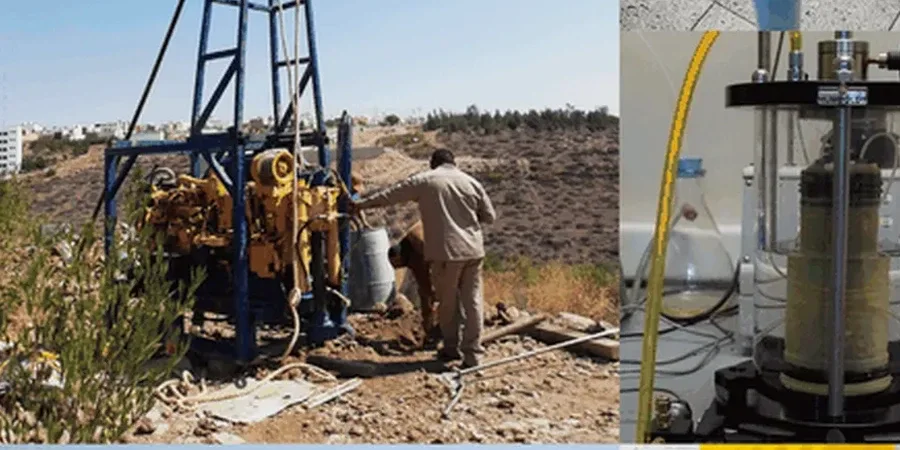
Critical ground factors in Trois-Rivieres
Trois-Rivières has a population of roughly 140,000 and sits on the seismically active Charlevoix-Kamouraska zone, which produced a magnitude 7.0 event in 1663. Modern NBCC seismic hazard maps classify the city as moderate-to-high risk. Poorly compacted fill amplifies ground motion and can settle differentially during shaking. The Champlain Sea clay underlying much of the city is prone to cyclic softening—a phenomenon where repetitive shear strains degrade undrained strength. Compacted structural fill that meets 95 percent standard Proctor at ±2 percent of optimum moisture provides a stiff buffer layer that attenuates strain before it reaches the foundation. Every density test we run in Trois-Rivières is a check against post-seismic settlement. On sites near the Saint-Maurice River where groundwater is within 2 meters, we also verify that the fill is placed above the water table and that no pumping has occurred during compaction.
Our services
brindamos un portafolio completo de actividades técnicos de densidad de campo (cono de arena) diseñados para proyectos de construcción, minería e infraestructura en Trois-Rivieres.
Compaction Testing Program
Full-service field density verification for structural fill, trench backfill, and pavement subgrade. Includes Proctor reference curves, lift-by-lift testing, and a compliance report signed by a geotechnical engineer. We coordinate directly with the earthworks contractor in Trois-Rivières to schedule tests as lifts are placed.
Troubleshooting Low Density
When compaction fails to meet the 95 or 98 percent specification, we run rapid Atterberg limits and grain size checks on the fill material to identify the root cause—often excess moisture, wrong soil type, or insufficient compactor passes. Remedial recommendations are provided within one working day.
Top questions
What does a sand cone field density test cost in Trois-Rivières?
Rates range from CA$140 to CA$220 per test point depending on site access, number of points, and travel distance within the Mauricie region. A typical day of testing with 6 to 8 points falls in the CA$900 to CA$1,400 range. Volume discounts apply for multi-day programs.
How long does it take to get sand cone test results?
Field measurements are completed in about 15 to 20 minutes per point. We send a preliminary report with dry density, moisture content, and percent compaction within 24 hours. The formal signed report follows in 48 hours and includes the Proctor reference curve, calibration data, and GPS coordinates for each test location.
How many test points does the NBCC require for compaction control?
The National Building Code of Canada references CSA A23.3 for structural fill, which calls for one density test per 150 to 300 square meters per lift, with a minimum of three tests per lift for small areas. The same frequency applies to engineered backfill under footings in Trois-Rivières. Utility trenches typically require one test every 15 to 30 linear meters per lift, depending on the municipal specification.
Can the sand cone test be used on coarse gravel with cobbles?
ASTM D1556 sets the practical limit at 38 mm particle size. If more than 20 percent of the material exceeds that size, the hole volume becomes unreliable and we recommend a water replacement method or a plate load test to verify modulus directly. On typical 0–20 mm granular base in Trois-Rivières, the sand cone works without issue.