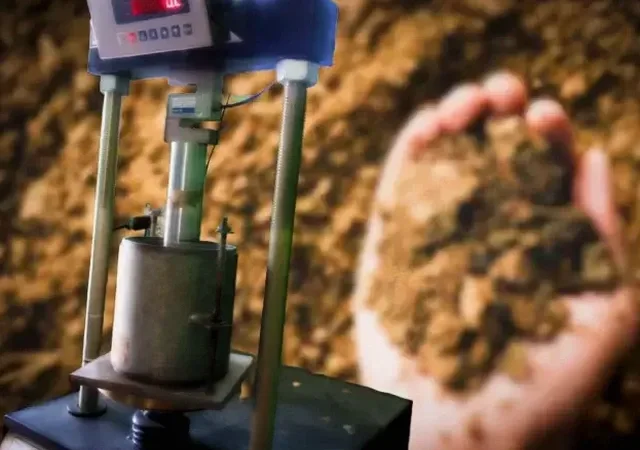
The Champlain Sea left Trois-Rivières with deep marine clay deposits that complicate any pavement job. Near the Saint-Maurice River, silt lenses trapped between till layers routinely produce CBR values below 3%, requiring lime stabilization before aggregate placement. The city’s 140,000 residents depend on arterial roads that must survive freeze-thaw cycling from December through March. A single laboratory CBR test run on a remolded specimen tells you whether the native silty clay can actually support the design traffic loading—or if you need to budget for full-depth replacement. Our team runs the soaked CBR procedure per ASTM D1883, compacting samples at optimum moisture from the Proctor curve, then submerging them for 96 hours to simulate the worst spring-thaw conditions the Mauricie region can deliver. When the test pit logs show variable stratigraphy across the right-of-way, we pair field sampling with lab compaction to give the pavement designer a defensible bearing capacity input.
A soaked CBR below 3% in Trois-Rivières marine clay means you are building on a sponge that will pump fines into your granular base with every freeze-thaw cycle.
Methodology applied in Trois-Rivieres
Critical ground factors in Trois-Rivieres
Trois-Rivières sits at an elevation of just 61 meters above sea level, with the water table often within 1.5 meters of the surface in spring. That shallow groundwater means a soaked CBR lab value is not a worst-case scenario—it is the baseline condition the pavement will see every year. Skipping the lab test and relying on field DCP correlations alone introduces a 20–30% error band in fine-grained soils, enough to under-design the granular base by 100 mm or more. The cost of that mistake shows up as alligator cracking within three seasons, followed by pothole patches that never bond properly. Municipal projects referencing the BNQ 1809-300 standard or MTQ specifications require laboratory CBR values for any road class above local residential. Even private commercial parking lots benefit: a 4% CBR subgrade with a properly designed asphalt section lasts twice as long as the same pavement on an untested clay subgrade that softens to 1% after a wet October.
Our services
The laboratory CBR test is one piece of a complete geotechnical investigation for pavement design. We coordinate the field sampling, transport, and lab scheduling so the soaked results are ready before the civil team finalizes the cross-section.
Soaked and Unsoaked CBR
We run the full ASTM D1883 procedure on remolded specimens compacted at project-specified density and moisture. The 96-hour soak gives the design CBR for the subgrade; unsoaked testing applies to granular base materials above the water table. Each report includes load-penetration curves, swell data, and the corrected CBR at both 2.5 mm and 5.0 mm penetration.
Paired Compaction and CBR Package
Because CBR depends entirely on density and moisture at compaction, we first determine the Proctor curve on the same material, then mold CBR specimens at the target compaction level. This package eliminates the disconnect between lab compaction data and bearing capacity—the two reports share the same sample, same classification, and same moisture-density relationship.
Top questions
What does a laboratory CBR test cost in Trois-Rivières?
A single-point soaked CBR test with Proctor compaction typically runs between CA$180 and CA$280, depending on whether it is standard or modified Proctor energy and how many points are tested on the compaction curve.
How long does the lab CBR test take from sample delivery to report?
Plan for five to seven working days. Compaction and specimen molding take one day, the 96-hour soak runs over four days, and the penetration test plus reporting fills the final day. Rush scheduling can compress this slightly if the lab runs the penetration on the same day the soak ends.
Do I need the soaked or the unsoaked CBR value for my pavement design?
For subgrade soils in Trois-Rivières, always use the soaked value. The shallow water table and spring thaw saturate the formation, and the soaked CBR represents what the subgrade will actually contribute during the critical weakening period. Unsoaked testing is reserved for free-draining granular base and subbase materials placed well above the groundwater level.