Designing deep foundations in Trois-Rivières demands strict compliance with the National Building Code of Canada (NBCC 2015) and CSA A23.3, given the city's location at the confluence of the Saint-Maurice and St. Lawrence rivers. The north shore terrain, with its layered silts and clays overlying glacial till, requires a pile foundation design approach that accounts for seasonal frost action and potential scour near the waterfront. Our technical team executes pile foundation design in Trois-Rivières by correlating in-situ test data with known regional stratigraphy, ensuring axial capacity calculations reflect the actual soil-structure interaction. For sites near the Cap-de-la-Madeleine bluffs, we often integrate findings from a seismic refraction survey to map bedrock depth before finalizing pile tip elevations.
In Trois-Rivières, ignoring the Saint-Maurice paleochannel deposits can turn a straightforward pile job into a costly settlement claim.
Methodology applied in Trois-Rivieres
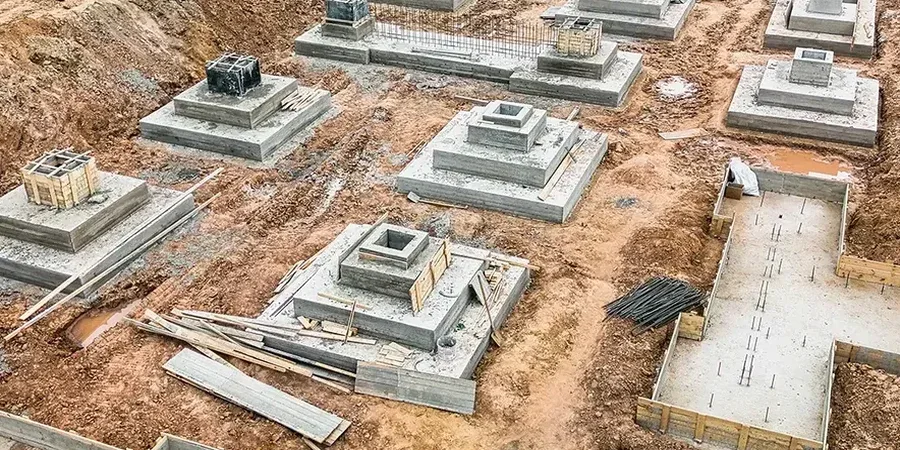
Critical ground factors in Trois-Rivieres
Trois-Rivières' industrial expansion along the riverbanks throughout the 20th century left a legacy of uncontrolled fill and buried debris in the lower-lying areas near the port. This urban history poses a direct threat to pile foundation design in Trois-Rivières: driving through old timber cribbing or foundry slag can damage pile toes and introduce negative skin friction if the fill settles around the shaft. Our design process includes a mandatory review of historical fire insurance maps and aerial photographs from the 1940s onward to identify former creek beds and infilled docks. Without this step, a pile foundation design in Trois-Rivières risks underestimating downdrag loads, a mistake that can lead to differential settlement between pile groups and costly remediation work after framing is complete.
Our services
Our pile foundation design service in Trois-Rivières covers the full lifecycle from geotechnical investigation to construction oversight. We select pile type, calculate capacities, and prepare sealed design drawings.
Static Capacity Design & Settlement Analysis
We compute ultimate and allowable pile capacities using the alpha and beta methods for fine-grained soils, referencing site-specific undrained shear strength profiles. Group settlement is estimated using the equivalent raft approach, critical for the compressible clays found across Trois-Rivières.
Pile Driving Monitoring & Testing
We perform dynamic load testing with PDA equipment to validate driveability and confirm capacity, adjusting hammer energy on the fly. Restrike testing is scheduled after pore pressure dissipation to capture setup effects common in the sensitive Leda-type clays of the St. Lawrence lowlands.
Top questions
What does a pile foundation design package for a Trois-Rivières project typically cost?
Professional fees for pile foundation design in Trois-Rivières generally range from CA$2,080 to CA$9,710, depending on the number of piles, the complexity of the soil profile, and whether dynamic testing is required. A straightforward residential addition on competent till will be at the lower end, while a multi-story waterfront development with lateral load demands and scour analysis will approach the upper end.
How does the NBCC 2015 seismic hazard affect pile design in Trois-Rivières?
Trois-Rivières sits in a moderate seismic zone along the St. Lawrence River. NBCC 2015 requires pile foundations to resist lateral earthquake forces without excessive deformation. Our designs include kinematic interaction checks for soft upper clays and ensure pile-to-cap connections can transfer the full moment demand per CSA A23.3.
Can you design piles for high groundwater conditions near the river?
Yes, high water tables are common in Trois-Rivières given the proximity to two major rivers. Our pile foundation design accounts for buoyancy effects on shaft resistance and specifies casing or drilling fluid for bored piles to maintain hole stability. We also consider the reduced effective stress when calculating long-term skin friction.
What happens if you encounter boulders during pile installation in Trois-Rivières?
Glacial till in the Trois-Rivières area often contains erratic boulders. If refusal is met prematurely on a boulder, we evaluate whether the pile can sustain the design load with a shorter embedment or if a heavier hammer or predrilling is needed. We always have contingency plans in the design package to avoid field delays.