Much of central Trois-Rivières sits atop deposits of the post-glacial Champlain Sea — sensitive silty clays extending 20 to 40 m deep, with undrained shear strengths often below 25 kPa. At the confluence of the Saint-Maurice and St. Lawrence rivers, groundwater is typically encountered within 2 m of grade, and the city lies in NBCC seismic category D. A conventional shallow footing in these conditions risks excessive total and differential settlement. Stone column design changes that picture: we install compacted gravel columns on a triangular or square grid, transferring load to a stiffer composite mass while providing a drainage path that accelerates consolidation. The design sequence starts with a site-specific CPT or SPT campaign — because without a continuous resistance profile, column length and replacement ratio remain guesswork. For projects near the riverbanks, where organic silts and peat lenses appear, we combine field data with laboratory consolidation tests to calibrate settlement predictions under the improved ground. That data feeds a design model accounting for column stiffness, area replacement ratio (typically 12 to 25%), and the modulus of the native soil, producing a foundation that meets serviceability limits under both static and seismic loading. Our team has applied this approach on commercial builds along Boulevard des Forges and on industrial tank pads in the Bécancour corridor, adapting each grid geometry to the layering encountered in the borehole logs. We monitor installation through real-time recording of amperage, depth, and stone volume per column, and verify the finished work with a plate load test on a representative column, confirming the stiffness assumed in the design model.
Stone columns in Champlain Sea clay work as stiff inclusions that share load and drain excess pore pressure — the design must get both mechanisms right.
Methodology applied in Trois-Rivieres
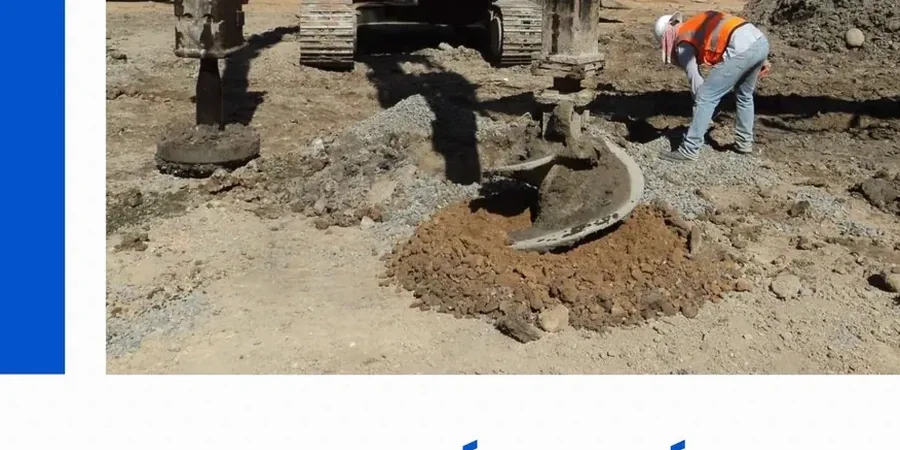
Critical ground factors in Trois-Rivieres
The freeze-thaw cycle in Trois-Rivières — where frost penetrates 1.2 to 1.8 m in an average winter — introduces a seasonal risk that tropical stone column references ignore. When the load-transfer platform is undersized or poorly graded, frost heave can lift the platform unevenly, breaking the load path between structure and columns. We specify a minimum 0.6 m granular platform with less than 5% fines and extend it 1.5 m beyond the column grid perimeter. Spring thaw saturates the upper crust, temporarily reducing effective stress and column confinement; the design checks that the factor of safety against bearing failure remains above 2.0 under this transient condition. Seismic demand from NBCC 2015 for site class E can amplify spectral accelerations at the ground surface — a risk we address by modeling the improved ground as a composite shear modulus, not as a rigid block, and by running the spectral analysis for the post-improvement site period. Where the stone columns terminate in soft clay overlying dense till, a sudden stiffness contrast can concentrate shear strain during shaking; we detail a transition zone of deeper columns along the grid perimeter to smooth that impedance change. The biggest operational risk, however, is poor installation QA: columns that daylight at the surface without reaching design depth, or stone bulging into soft organic pockets. Our field protocol records depth, amperage, and stone consumption every 0.5 m, flagging any column that deviates from the design profile before the rig leaves the position.
Our services
Our stone column scope in Trois-Rivières spans the full cycle — from geotechnical investigation through design, installation supervision, and post-treatment verification. Each phase is calibrated to the Champlain Sea stratigraphy and the performance requirements of the structure.
Geotechnical Investigation & Design Data
CPT soundings with pore-pressure measurement and select SPT borings to map the clay thickness, tip resistance, and groundwater profile. We integrate lab consolidation and triaxial tests to define the compressibility and strength parameters feeding the column design model.
Stone Column Design Package
Grid geometry, column diameter and depth, area replacement ratio, load-transfer platform specification, settlement and bearing capacity calculations under static and seismic loads, liquefaction mitigation assessment, and installation tolerances. Stamped by a professional engineer licensed in Quebec.
Installation QA/QC & Verification Testing
Full-time field supervision with real-time monitoring of vibrator depth, amperage, and stone volume per column. Post-installation plate load tests on 2–5% of columns to confirm stiffness, plus survey monitoring of settlement during and after construction.
Top questions
What soil conditions in Trois-Rivières make stone columns the right foundation solution?
The primary driver is the presence of soft, sensitive Champlain Sea silty clays with undrained shear strength below 30 kPa, often extending more than 20 m deep. When the water table is within 2 m of grade — typical for sites near the Saint-Maurice and St. Lawrence rivers — and the seismic site class is D or E per NBCC, stone columns offer a dual benefit: they reinforce the weak clay through compaction and load transfer, and they create vertical drainage paths that speed up consolidation settlement. For structures with allowable bearing pressures in the 50–100 kPa range and strict settlement limits, this ground improvement technique can eliminate the need for deep pile foundations.
How is stone column design validated after installation in Trois-Rivières?
We verify the design through a combination of real-time installation records and post-treatment field testing. During construction, the vibrator logs depth, hydraulic pressure or amperage, and stone consumption every 0.5 m — any column that does not reach the design depth or meet the target stone volume is flagged immediately. After curing, a plate load test is performed on 2 to 5% of the columns applying 150–200% of the design working load; the load-settlement curve must match the design stiffness within a 15% tolerance. For large sites, we may also run a few CPT soundings between columns to confirm the increase in tip resistance and the reduction in pore pressure dissipation time.
What is the typical cost range for stone column design and installation in the Trois-Rivières region?
The combined design and installation cost for stone columns in the Trois-Rivières area generally falls between CA$2,180 and CA$6,970 per column, depending on column diameter, depth, grid density, and site access conditions. A full design package — including geotechnical investigation, engineering calculations, stamped drawings, and QA/QC supervision — is quoted separately based on project scope. The total project cost is influenced by stone availability, mobilization distance, and whether the work is seasonal (winter conditions may require platform insulation or temporary heating).
How does the design account for seismic loading in Trois-Rivières?
Trois-Rivières falls under NBCC seismic category D, and many sites are on site class D or E due to the thick clay deposits. The design incorporates a site-specific seismic hazard assessment using the 2015 NBCC spectral accelerations. The improved ground is modeled as a composite material with an equivalent shear wave velocity derived from the column stiffness and the native clay modulus. We run a liquefaction triggering analysis for any interbedded sand layers, and if the factor of safety drops below 1.1, the stone column grid is extended beyond the building footprint to create a non-liquefiable perimeter zone. The load-transfer platform is also checked for shear capacity under the seismic base shear transferred from the structure.