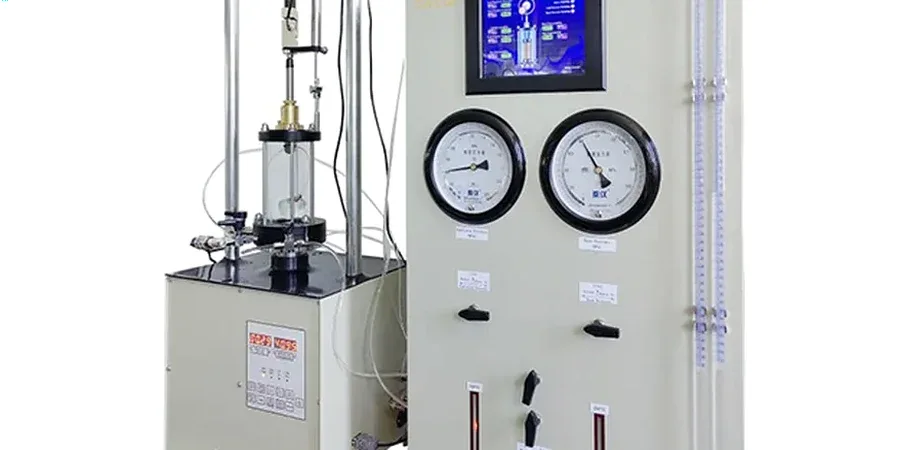
Trois-Rivières, wedged between the St. Lawrence River and the Saint-Maurice River, carries a layered subsoil story that dates back to the post-glacial Champlain Sea. The city’s industrial port heritage and its rapid residential expansion into areas like Cap-de-la-Madeleine have placed foundations directly over sensitive marine clays and compact glacial tills, often within the same building footprint. When a project demands precise shear strength parameters—cohesion and friction angle—under controlled drainage conditions, the triaxial test becomes the reference method. Our laboratory team receives Shelby tube samples from downtown boreholes, from the Technoparc, and from riverside condominium sites; we run consolidated-undrained and consolidated-drained stages on silty clays and fine sands that standard penetration tests alone cannot fully characterize. For projects where the soil profile includes interbedded silt lenses, we often pair the triaxial program with CPT testing to correlate laboratory strength envelopes with continuous in-situ tip resistance, giving the structural engineer a complete picture before designing deep foundations or basement slabs.
Effective stress parameters from a triaxial test often reveal a 15–25% difference in shear strength compared to total stress assumptions, directly impacting foundation sizing in Trois-Rivières clays.
Methodology applied in Trois-Rivieres
Critical ground factors in Trois-Rivieres
In the Saint-Maurice valley, we frequently encounter soil profiles where a stiff desiccated crust masks softer, normally consolidated clay underneath; designers who rely only on shallow index tests or SPT blow counts can overestimate the undrained shear strength by a factor of two or more. The triaxial test exposes this risk by reproducing the in-situ stress state before shearing: a sample consolidated to 120 kPa when the real overburden pressure at 10 meters is closer to 180 kPa will return a cohesion value that is dangerously optimistic. Another local pattern is the presence of laminated silts with thin sand partings—these drain during sampling and partially lose their structure, so the triaxial cell must restore saturation carefully, otherwise the measured friction angle comes out artificially high. We have also seen projects near the old industrial canal where hydrocarbon traces in the pore fluid alter the effective stress response; running a chemical analysis on the pore water before the triaxial program helps avoid surprises during the CU stage.
Our services
Our Trois-Rivières geotechnical program integrates laboratory triaxial testing with complementary field and lab methods to build a defensible ground model for your project:
CU and CD Triaxial Testing
Consolidated-undrained and consolidated-drained tests on cohesive and cohesionless soils, with full pore pressure monitoring and stress path reporting.
Field Sampling for Laboratory Strength
Shelby tube and piston sampling in Trois-Rivières soft clays, with strict transport and storage protocols to preserve sample quality for triaxial testing.
Correlation with In-Situ Penetration Tests
We cross-reference triaxial strength envelopes with CPTu and SPT data to calibrate site-specific correlations for the St. Lawrence lowlands.
Geotechnical Parameter Reports
Interpretative reports delivering Mohr-Coulomb parameters, undrained shear strength profiles, and stiffness moduli for direct input into PLAXIS or FLAC models.
Top questions
How much does a triaxial test program cost for a project in Trois-Rivières?
A standard triaxial testing program, including three specimens from one borehole depth with consolidation and shearing stages, typically ranges from CA$2,810 to CA$3,400 depending on the number of confining pressures and whether drained or undrained conditions are specified. Multi-depth programs or stress path tests with local strain measurement adjust the scope and are quoted accordingly after reviewing the geotechnical investigation plan.
When do you recommend CU over CD testing for Trois-Rivières clay?
Consolidated-undrained tests with pore pressure measurement are the standard choice for the Champlain Sea clays found across Trois-Rivières because they deliver both total and effective stress parameters in a single stage. We recommend drained (CD) tests when the design scenario involves long-term loading where excess pore pressures have dissipated—for example, permanent retaining walls or embankments on free-draining granular layers. The decision always ties back to the construction timeline and the drainage characteristics of the specific stratum.
What sample quality do you need for a reliable triaxial test?
Undisturbed sampling is essential: we work with Shelby tubes or piston samplers that preserve the natural structure and water content of the soil. Samples must be sealed immediately on site, transported upright, and stored at controlled temperature. In Trois-Rivières, where sensitive clays can lose strength from vibration during transport, we often coordinate directly with the drilling crew to minimize handling and transit time. Any tube showing signs of disturbance upon extrusion is rejected before specimen preparation.