Trois-Rivières grew outward from the St. Lawrence River terraces onto deep post-glacial sands, and that expansion left a legacy of loose, water-saturated deposits beneath industrial and residential zones alike. A standard shallow foundation on these soils can settle differentially within the first five years—sometimes enough to crack partition walls or misalign bridge approach slabs. Vibrocompaction design tackles this directly: it rearranges the granular skeleton into a denser state, cutting future settlement before the first structural load is applied. Where the Mauricie region’s seismic hazard combines with a shallow water table, densification becomes more than a settlement fix—it becomes a liquefaction mitigation measure. We prepare site-specific compaction grids using CPT pre-investigations, adjusting vibrator frequency and spacing to the grain-size profile found at each borehole, so the final design reflects the real variability of the Trois-Rivières subsurface rather than a textbook assumption.
A well-designed vibrocompaction grid in Trois-Rivières alluvium can raise relative density from 45 % to over 75 %, reducing post-construction settlement to less than 15 mm.
Methodology applied in Trois-Rivieres
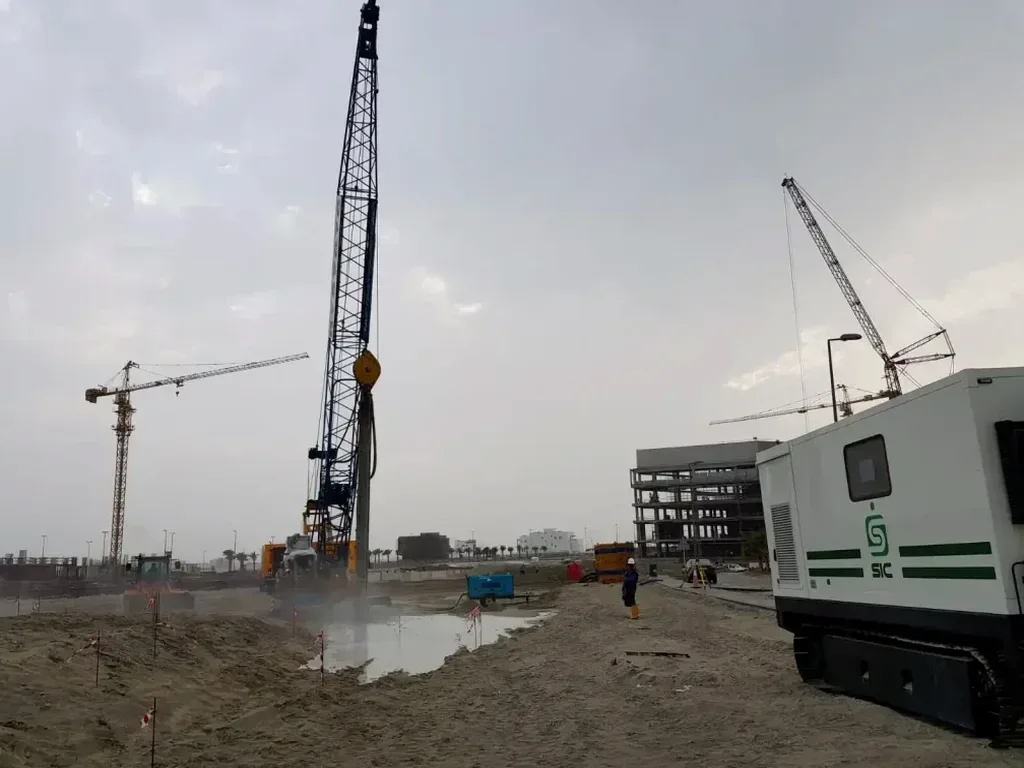
Critical ground factors in Trois-Rivieres
The vibrator rig itself—typically a crawler-mounted leader with a 130 kW electric motor driving an eccentric mass at 30 Hz—descends into the Trois-Rivières sand with a controlled water flush, and the real risk hides in what that water does to the surrounding ground. If the flush rate is misjudged, excess pore pressure builds up in the silty lenses that are common in the Champlain Sea-derived deposits, temporarily weakening the soil instead of densifying it. We monitor pore-pressure response in real time through piezometers installed at the perimeter of the treatment zone, pausing or adjusting the grid when readings approach critical thresholds. Another risk specific to this city is the presence of buried wood debris from the 1908 Great Fire; a vibrator hitting a buried timber lens can deflect and leave an untreated column, so we cross-reference historical fire maps with the compaction grid before mobilization to avoid surprises that compromise the final design density.
Our services
Our vibrocompaction design package goes beyond specifying a grid pattern; it includes the full geotechnical context needed for a defensible, constructible ground improvement contract in the Mauricie region.
Performance-Based Compaction Design
We develop vibrocompaction specifications tied to measurable post-treatment criteria—minimum CPT tip resistance, maximum allowable settlement under design load, and liquefaction factor of safety—rather than prescribing only vibrator spacing and duration.
Pre- and Post-Treatment Verification
The design package includes a testing schedule with CPT soundings and SPT borings before and after treatment, plus pore-pressure dissipation tests where silty layers are present, giving the owner independent confirmation that the target density has been achieved across the entire footprint.
Top questions
What soil conditions in Trois-Rivières make vibrocompaction suitable?
Vibrocompaction works best in clean to slightly silty sands with fines content below 15 %, which are common in the St. Lawrence River terrace deposits underlying much of Trois-Rivières. When the grain-size distribution from a sieve analysis passes this threshold and the water table is within a few meters of grade, the technique is highly effective for densifying to depths of 15–25 m.
How do you verify that the compaction achieved the required density?
We compare pre-treatment and post-treatment CPT soundings at the same locations, looking for a minimum increase in tip resistance that corresponds to the target relative density. Supplementary SPT borings and, in sensitive zones, pressuremeter tests deliver independent confirmation, and all results are reported against the acceptance criteria stated in the design.
Does your vibrocompaction design address earthquake liquefaction?
Yes. We evaluate the liquefaction factor of safety using the CPT-based method of Robertson and Wride, calibrated to the NBCC 2015 seismic hazard for Trois-Rivières, and design the compaction grid to achieve a factor of safety of at least 1.2 under the design earthquake.
What does vibrocompaction design cost for a typical commercial building in Trois-Rivières?
Design fees typically range from CA$1,980 to CA$7,090 depending on the treated area, depth of improvement, and the number of pre- and post-treatment verification tests required. The cost includes the compaction grid plan, technical specification, and verification testing protocol.
Can vibrocompaction be used near existing structures in the older parts of the city?
It can, but with additional precautions. In built-up areas of Trois-Rivières we conduct vibration monitoring with seismographs placed on adjacent structures and set peak particle velocity limits agreed upon with the owner. The compaction sequence is designed to start farthest from sensitive buildings and move inward, and we often reduce the vibrator energy in the rows closest to existing foundations.